Who Do You Love?

Golden Calf

I read the story of the children of Israel and the golden calf the other day, preparing a lesson I was writing for my publisher.

It’s pretty incredible.  Just a few weeks before, they’d been enslaved in Egypt.  Forever.  And yet, God performed miracles and signs and wonders–and they escaped to freedom.  At the Red Sea, when it appeared that the end was near, God performed another miracle and opened the water so they could walk across on dry land.  Amazing.

And yet, here they are, a little bored because Moses is taking too long talking to God up there on Mt. Sinai, and they start to wonder if maybe they could get a distraction.

So they get Aaron to make them an idol.  A calf of gold.  And they start worshipping it.

We think that’s pretty weird from our view here in the 21st century.  It’s weird that they start dancing around and singing and praying and worshipping an idol.  But it really got me thinking–God’s commandment about idols is still pretty relevant.  Our idols may not look like golden calves, but our society still places the emphasis on the wrong thing.  Even people who say they love God can let their priorities get out of whack.

We’ve all seen it.  It’s just not a golden calf.

It’s the Beatles.


It’s Frank Sinatra.

It’s cosplay.

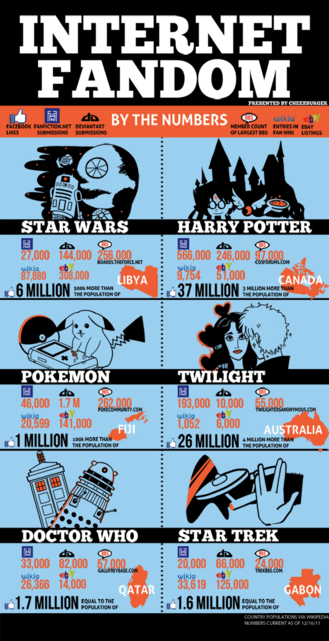
It’s fandom.  In whatever form.

Fandom Infographic

It’s cars.

Cars

It’s your favorite vacation spot.

Disneyland

It’s your phone of choice.

iPhone 5S

It’s sports.

Fans

An idol can be anything–anything–that causes you to place its importance higher on your priorities than your relationship with God.  This isn’t easy.  I have several things on this list that I look at and say, “Wait a minute!  That’s not an idol!  That’s just a place I really love…”  But if I spend an inordinate amount of time focusing on any of those things (cough*DISNEYLAND*cough), then it’s an idol.

The thing itself isn’t bad.  What makes it an idol is how I treat it.

So the story of the golden calf isn’t God’s way of telling us in the 21st century to avoid melting our gold into statues of livestock, it’s a reminder that no one, nobody, and nothing deserves a higher place in our lives than Him.  And if you have something that you think about–read about–dream about–search the internet about–more than Him, well, it’s your idol.

As I researched my article, I ran across this video.  It reminded me that idol worship is alive and well today.

And it’s not just about golden calves anymore.

The Visionary Importance of Otter Pops

Image

I am on vacation this week.

That may sound easy, but the trouble is vacation is never quite as easy when you’re a pastor.  Mostly because there’s this one day of the week that really requires you to actually be there for everything to “work.”

Sundays are never easy for pastors to take off.  Just like many people, we worry that our team won’t do the job as well as we will.  We worry that they’ll miss the big picture–or maybe the small details.  We worry that the worship won’t be as good or that the substitute preacher you’ve placed in your pulpit will blow their opportunity to share the message.

It doesn’t matter if you’re the pastor of a large church or a small church.  It doesn’t matter if you’re a lead pastor or a children’s pastor.  When vacations coincide with Sunday, there isn’t a single one of us that doesn’t think–if we are truly honest with ourselves–that it probably won’t be as good this week.

I proclaimed a week ago, the day before I went on vacation, that the next Sunday would be Otter Pop Sunday.  I told the kids I would be gone, but every kid who came to church the next weekend would get one of those delightful frozen treats.  My team looked at me with amused worry when I made the announcement.

But here’s where you know if you’re successful as a leader or a pastor.  If you have entrusted the people you lead not just with the job, but with the vision, they’ll figure out how to not only get the tasks done, but to understand the why behind the task.

Otter Pops are not very good until they are left alone, in the freezer, to do the very thing that makes them so good: freeze.  Your team that you lead won’t be very good until you leave them alone, in the busyness of ministry, to do the very thing you have trusted them to do: minister.

I’m proud to say that the gave out over 500 Otter Pops to elementary aged kids at two campuses across three services.  I’m proud to say that my team did a great job this weekend and we had record numbers of kids on a weekend when I was out of town.  But I’m most proud to say that when they saw problems, they fixed them, and when left to do what they were trusted to do, they did it well.

Otter Pop Sunday may just become a regular thing when I go on vacation.  Who knew something so simple could be so important?

Being Alive

Being AliveFrom one of my favorite composers, a beautiful, truthful lyric on marriage that never fails to move me every time I hear it.

Someone to hold you too close.
Someone to hurt you too deep.
Someone to sit in you chair,
To ruin your sleep.

Someone to need you too much.
Someone to know you too well.
Someone to pull you up short,
And put you through hell.

Someone you have to let in,
Someone whose feelings you spare,
Someone who, like it or not,
Will want you to share
A little, a lot.

Someone to crowd you with love.
Someone to force you to care.
Someone to make you come through,
Who’ll always be there,
As frightened as you,
Of being alive,
Being alive.

Somebody hold me too close.
Somebody hurt me too deep.
Somebody sit in my chair,
And ruin my sleep,
And make me aware,
Of being alive.
Being alive.

Somebody need me too much.
Somebody know me too well.
Somebody pull me up short,
And put me through hell,
And give me support,
For being alive.
Make me alive.
Make me alive.

Make me confused.
Mock me with praise.
Let me be used.
Vary my days.

But alone,
Is alone,
Not alive.

Somebody crowd me with love.
Somebody force me to care.
Somebody make me come through,
I’ll always be there,
As frightened as you,
To help us survive,
Being alive.

— Stephen Sondheim, “Being Alive,” from Company.  (1970)

School. Is. Almost. Done.

Summer is Coming

And I’m glad.

I think I dislike the school year more than my kids do.

I dislike homework.

I dislike studying.

I hate quizzes.

I dislike reading logs and state capital quizzes.

I dislike all of it.

I like summer mornings.  I like the kids sleeping in.  I like waking up to sunshine and going to bed hearing sprinklers.  I like kids playing outside and creating memories as a family and getting in the car and going out for ice cream just because it felt like an ice cream kind of day.

School gets in the way of all that.

Oh, it’s necessary.  It’s good for my kids to grow in wisdom and stature and in favor with God and man.

But we have only 3 1/2 days of school left.

And then summer is finally here.

So don’t mind me if I’m a little distracted.  School’s almost out.  The sun is shining.
And I’ve got memories (that will last far longer than a memorized fact or an algebra equation) to create with my family.

O Vos Omnes

O Vos Omnes

Most people I know today would be surprised to discover that while in college I was part of a very traditional, “high church” style choir called the Biola Chorale.  For four years, this group of people were my best friends and it was probably my deep love and involvement in the choir that caused me to take the four and a half year road to graduation as an English major.

One of the things I most appreciated and loved about the Biola Chorale, besides the friends and music, was the director, Loren Wiebe.

He remains one of the most influential men in my life, who spoke words of wisdom that were much needed by the young man I was.  He was a mentor, encourager, conductor, and, as I reflect tonight, spiritual father.

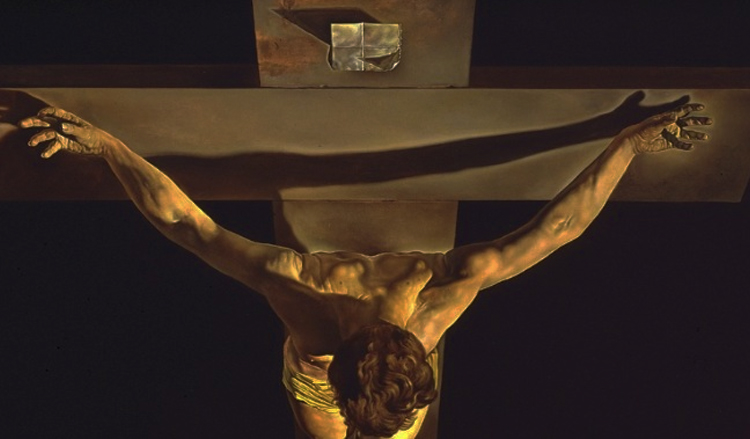
Mr. Wiebe has a deep and abiding love for his Savior.  Every concert we did on tour was a celebration of that love.  We sang songs of joy and happiness.  We sang spirituals and deeply personal songs.  We sang songs in German, Latin, English.  And we frequently spent a large portion of our concerts focused on the death and sacrifice of Jesus Christ.

Everything from movements from Bach’s choral work, “Christ Lay in Death’s Dark Prison” to a beautiful and haunting acapella arrangement of the final verse of “O Sacred Head Now Wounded.”

But the most moving and memorable reflection on the death of the Savior was an amazingly difficult, terrifyingly hard to perform, and yet altogether astounding acapella song by composer René Clausen, a 9 minute journey through the death of Jesus called “O Vos Omnes.”

Translated into English, it means “All who pass by,” and uses a verse from Lamentations (“All who pass by, see if there be any sorrow like unto my sorrow”) as its base.  In stunning bass and tenor lines, beautiful haunting words from alto and sopranos, using every combination of chant, traditional hymn, Latin, English, and Hebrew words (Jesus’ words, “Eli, eli, lama sabacthani” are alternately sung, chanted, nearly shouted) possible to create a choral image of the last moments of Jesus’ life on that Good Friday.

I don’t have a recording of the Biola Chorale singing it, but I have this amazing arrangement by the Concordia Choir that is nearly as good.  I can still picture the tension of the moments in a concert leading to this song, which took everything out of the singers.  I can still see Mr. Wiebe conducting it, pushing the quiet moments to near silence while nearly clenching his fists as the louder moments filled a quiet concert hall.  His eyes closed, it was clear his heart was full–full of sorrow, of gratitude, of wonder at the astounding sacrifice of the Savior.

Thank you, Mr. Wiebe, for this song, and for helping me not rush too quickly to Easter morning–to savor the quiet and the darkness and the sadness of the night the Savior was crucified for me.

The Genius of John Williams, Part One

If you were to try and name America’s greatest composer, you could name some amazing individuals. Leonard Bernstein. Aaron Copland. Charles Ives.

But as great as these composers are, none of them have had the impact on the public at large as an individual who has been actively composing for nearly 50 years and has left an indelible mark on American culture and popular culture on a global scale.

John Williams.

From humble beginnings as jazz pianist, he eventually worked with some of the greatest film composers of the 1950’s–Bernard Hermann, Alfred Newman, and Franz Waxman–and wrote his first film score for a lamentably awful crime film, Daddy-O. (Here’s a sample of one of the songs from the film–understandably, nobody will claim credit today for the songs–but it’s Williams’ name on the credits, so he takes the blame.)

Going on to write for television, he composed the memorable theme songs for The Time Tunnel and Land of the Giants and even scored the first episode of Gilligan’s Island.  Eventually segueing into film full time, Williams adapted the music for Fiddler on the Roof and won his first Oscar.  Eventually, he would team up with director Steven Spielberg and begin to leave his indelible mark on the musical landscape, virtually reinventing the modern film score and creating a body of work for the six Star Wars films that totaled more than 14 hours of music.

Unlike many film composers, however, Williams also branched into concert works and actual symphonies, chamber pieces, and more.  As the conductor of the Boston Pops for nearly 20 years, he continued conductor Arthur Fiedler’s mission of bringing classical music to the masses and exposing generations of young people to the brilliance and beauty of the orchestra.  His themes for several different Olympic games as well as his theme for NBC Nightly News continue to leave their mark on the musical landscape.  Composing in nearly every style, for nearly every genre of film, Williams, unlike any American composer before him, has become part of the cultural zeitgeist that will live for as long as anyone hears his now familiar scores.

This appreciation of his genius is my simple attempt to honor a man whose musical work I have long admired–my attempt to highlight and familiarize others with some of the best examples of his work.  Whether in film, television, the concert hall, or the Olympic stadium, Williams is a true master of the symphonic work and leaves behind a rich legacy honoring that genius.

Fiddler on the Roof (1971).  Working with violinist Isaac Stern, his adaptations broadened and added a whole new life to the song score, as evidenced in the opening titles for the film, featured after the famous prologue, “Tradition.”  On his second nomination, Williams won his first Academy Award for this brilliant adaptation.

Jane Eyre (1971).  Before breaking it big into film, Williams returned to his television roots to write the score for an adaptation of Jane Eyre starring Susannah York and George C. Scott.  This score is easily one of his best, highlighting his romantic side–sweeping strings, beautiful piano work, and subtle emotion highlighting the struggles of the two main characters.

[ JOHN WAYNE AND THE COWBOYS POSTER ]

The Cowboys (1972).  One of his first original film scores, this shows that Williams is a master of the western idiom, borrowing from Aaron Copland’s Rodeo (as has every composer of Western film music since), but also imbuing it with an original, robust brassiness.  With only a handful of films in this genre in his oeuvre, it’s a shame he didn’t do more Westerns.  This is a suite of themes from the film.

Jaws (1975).  The film score that made “John Williams” become known outside of Hollywood and his second collaboration with Steven Spielberg.  One of film’s most recognizable musical motifs–the rampaging shark’s rhythmic, swelling two-note figure–won the composer his first scoring Oscar. Williams’ score is one of the key elements of the film’s gut-wrenching success, a shrewdly manipulative orchestral work that in one bar makes you feel the fun of hanging out at the beach, the horrors of being eaten alive the next. There is not a lot of melody here–mostly motifs that evoke emotional responses–but that doesn’t diminish the power of the composer’s use of two simple notes.  Today’s film composers wish they had created something this amazing.  Out of two notes.

Midway (1976).  For his next big film score, Williams went from the motifs of Jaws to the military marches of Midway.  Highlighting the greatest battle in the Pacific during World War II, the film was an all-star event and Wililams music is big enough to match the moment and the film.  It’s interesting to compare his subtle work on Jaws with the militaristic march of Midway, but clearly Williams has a little John Philips Sousa in him as well.  This served as the end title music for the film.

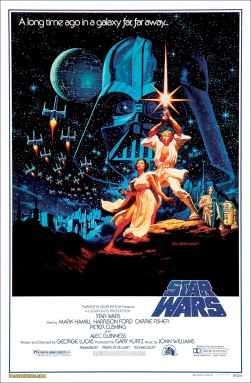
Star Wars (1977).  When a little space adventure that nobody expected to become the biggest film of all time opened in 1977, not only did director George Lucas launch the modern age blockbuster, he also helped bring about the rebirth of the big orchestral film score.  Lucas had originally intended for the movie to be tracked with his favorite symphonic classical pieces, including a few Golden Age film scores, but buddy Steven Spielberg convinced him to hire John Williams for the job.  Williams brilliantly brought back the idea of leitmotif, which was a hallmark of the operas of Richard Wagner and the works of composer Gustav Holst.  Leitmotif gives each character a theme that will be heard throughout their character arc and in Star Wars gave hero Luke Skywalker, Princess Leia, Darth Vader, and the rest, recognizable, memorable themes that helped shape the emotional response to their adventures.  The most memorable leitmotif in the film is the Skywalker Theme–which most of us know as the music that blasts the theater when the words “Star Wars” appear on screen, appearing in this track as part of the End Titles.  Here, we hear the Trumpet Fanfare which is the theme for “The Force,” Luke’s theme, and Princess Leia’s theme.  Hard to believe it now, but this music changed the face of film scores forever, and was voted the Best Film Score of all time by the American Film Institute in 2005.

This is just the beginning.  Part Two continues looking at the genius of America’s greatest living composer.

Do You Hear the People Sing?

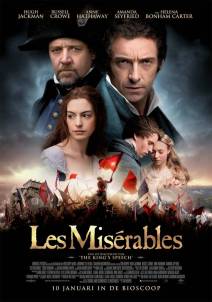
LES-MISERABLES-Poster

The new film Les Misérables, based on the worldwide musical smash and Victor Hugo’s best-loved novel, is a story of the power grace has to transform and change lives–and the choice we make when faced with forgiveness.

The story of Jean Valjean has been adapted many times, and it is an enduring one because of the grandness of the story and its scope and drama. Convict Jean Valjean is finally paroled after twenty years in hard labor.  Reminded of his state by Inspector Javert, Valjean realizes that even after having paid for his crime–stealing a loaf of bread–he will never be forgiven.  When the Bishop of Digne surprises him with an unbelievable act of charity and grace, Valjean rejects who he has been and embraces the forgiveness offered, forever changing his life and setting him on a lifetime game of cat-and-mouse with the relentless and unmoving Javert.

A huge cast of characters crosses the two men’s paths–Fantine, who falls to a lowly state while trying to protect her only child, Cosette.  Thenardiér, a veteran of Napoleon’s wars who, with his wife, bleeds Fantine dry of her money to support their own daughter, Eponine.  Marius, a son of aristocracy who has fallen in with Enjrolas and other revolutionary-minded students.  Gavroche, a boy living on the streets of Paris as a pickpocket.  Eventually, all of their stories meet up at the failed student uprising of 1832 and a battle in the streets of Paris.  It’s an epic tale, full of chases, secret identities, broken hearts, young love, tragedy, war–everything that makes for a great story.  There’s a reason Hugo’s story has been adapted for theater and film so often since it was first published.
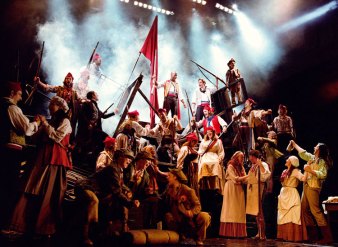
I first encountered what was already billed as “The Musical Sensation” in 1987, after reading an article in Newsweek about the new show that was breaking records in London’s theater scene.  Intrigued enough by what I had read, I picked up a copy of the unabridged edition of Hugo’s novel and was overcome by the depth of storytelling, character development–and some amazing sidelines into French history, social issues, and politics that are mostly left on the sidelines in adaptation.  I bought the London Cast album and fell instantly in love with the sung-through musical, almost operatic in scope, filled with powerful ballads, soaring marches, and amazing performances by the original cast, mostly made up of Shakespearean actors.

As you may have guessed, I’ve been waiting for a film version of Les Misérables for a very long time.

It doesn’t disappoint.

From the opening moment, when instead of a few lone convicts on a dark stage, we see a contingency of convicts struggling to pull a ship into dock in the midst of a rainstorm, it is clear that director Tom Hooper (Oscar winner for The King’s Speech) is going to expand what was only hinted at onstage, giving the music a chance to soar in settings just as big and bold.  Unlike most movie musicals, however, the singing was not dubbed.  As the convicts struggle with the boat, their cry of “Look down” may not be beautifully sung, but it sung with passion and heart that isn’t there when an actor is only lip synching something recorded in a comfortable studio months earlier.
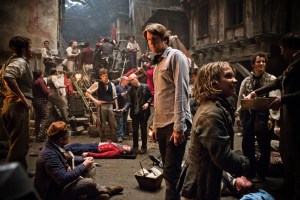
Tom Hooper on the Set of Les Miserables This is also the strength of Hooper’s direction–the bigness of the musical’s songs is met in a scope to match–but the intimacy that is lost in the perfect singing of so many film musicals is gained in the fact that the songs truly seem to spring from the moment, out of the depths of the character’s hearts and emotions.  When Jackman sings Valjean’s “Soliloquy,” where he realizes that God’s grace can pierce his hardened soul and forever alter his life, the break in his voice heightens the emotions that even the great Colm Wilkinson (the original stage Valjean who has a pivotal cameo as the Bishop of Digne) could never portray in a recording the way he did on stage.

Hugh Jackman as Jean ValjeanThere’s a “realness” to the songs that one gets when seeing a musical onstage, where interpretations change based on how the actor is feeling in that given performance.  When Anne Hathaway (in a truly tremendous performance as the heartbreaking Fantine) sings “I Dreamed a Dream,” it’s not a beautiful moment.  But it stops the viewer in their tracks, realizing that she is singing it live as her hair is shorn, her body reduced to ruin, so that when she sings “I had a dream my life would be so different from this hell I’m living,” you feel it.  It’s one of the most amazing moments in any film this year.
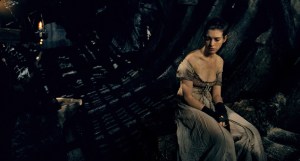
Anne Hathaway as FantineThe performances are all first-rate, with Hugh Jackman deftly carrying the entire film on his shoulders.  His singing is as good as it has always been, as the man who is Wolverine is no stranger to theater.  He also brings great depth to Valjean’s struggle as he realizes that the child who has helped him truly change his life no longer needs him.  Russell Crowe, as the relentless Javert, brings a steely-eyed countenance to the role and surprises with a good, if not great, voice.  His final moments in the film, when he realizes that he cannot reconcile his love of the law with the grace shown to him by Valjean during the climactic battle, is truly powerful, and he sings his version of the “Soliloquy” with equal parts gusto and sadness.

Russell Crowe as JavertThe supporting characters are all well-played, with Sacha Baron Cohen and Helena Bonham Carter doing exactly what you would expect as the dastardly-yet-funny Thenardiérs.  They both shine in roles that seem made for their brand of scenery chewing, and both sing better here than they did in their last musical, Sweeney Todd.  Eddie Redmayne is a wonderful “find” as the student and star-crossed lover, Marius.  Although this is not his first role, it is truly a breakthrough performance and he sings the soaring tenor role quite well.  Also of note are Samantha Barks as Eponine, whose unrequited love for Marius is sung heartbreakingly in “On My Own,” and Aaron Tviet as Enjrolas, the student who leads the ill-fated rebellion.
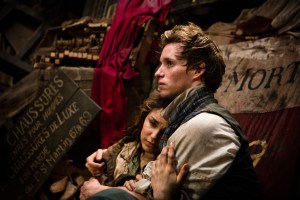
Eddie Redmayne as Marius and Samantha Barks as Eponine
Beautifully filmed, with some unconventional choices (some extreme close-ups during a few of the songs can be disconcerting to some), the movie’s sets and costumes are also first-rate.  The squalor and upheaval of early 19th-century France are conveyed with a vividness that would have made Victor Hugo proud. Yet, it also showcases beautifully the ultimate themes of the novel.

In the big moment before all the stories collide at the barricade, the entire cast sings the song “One Day More,” which is a powerful moment both onstage and in the film.  Every story is about to connect, and they all sing out, “Tomorrow we’ll discover what our God in heaven has in store!” This is why, while some today may wish to equate the “Occupy” movement with the students of 1832 and say social awareness was Hugo’s true theme, I would disagree.

For Hugo, the events of 1832, the troubles of “Les Misérables” are but a grand canvas to write and portray the grander theme: man’s salvation, the gift of redemption, and the inability of the law to reconcile itself with grace.  In the soaring songs of Les Misérables, the call isn’t for more government, more programs.  What will truly bring about Hugo’s revolution is when mankind can treat each other the way the Bishop treated Valjean: with surprising grace, unmerited and undeserved.  This is what is sung at the final scene of the film–as all who have died in the course of the story join thousands of other voices who sing

Will you join in our crusade?
Who will be strong
and stand with me?
Somewhere beyond the barricade
is there a world you long to see?
Do you hear the people sing,
say do you hear the distant drums?
It is the future that they bring
when tomorrow comes!

Les Misérables is more than just perhaps the greatest film musical of all time.  It’s also the most moving and powerful movie–the best picture–of the last year.

Top Ten Films of 2012

2012 Films


10. The Woman in Black — a stylish, truly scary Victorian tale with a great first post-Harry Potter performance by Daniel Radcliffe.  Some genuine fright moments wrapped in a wonderful production design offset an ending that leaves a little to be desired.

9. The Odd Life of Timothy Green — a family film in the best sense of the word, celebrating the bonds of parent and child, relationships, and the impact one life can have on another.  Child actor CJ Adams is simply outstanding as the title character, who grows from the garden after one magical thunderstorm.  The pencil idea in the movie would be great if someone could figure out how to do it in real life.

8. Lincoln — another great performance by Daniel Day-Lewis in another outstanding film from Steven Spielberg made this version of Lincoln’s story one of this year’s best, with great supporting performances, and another outstanding score by John Williams.  Anachronistic use of curse words are the only drawback to an otherwise outstanding film.

7. The Hobbit: An Unexpected Journey — surprisingly great first film in a trilogy based on Tolkien’s slightest book, with a great return to a wonderful character by Ian McKlellan as Gandalf and a wonderful, all-it-should-be moment of “Riddles in the Dark” between Bilbo and Gollum.  Martin Freeman, as Bilbo Baggins, is perfectly cast and adds a much-needed sense of humor and fun to a film that is full of somber dwarves.

6. The Hunger Games  — a film far superior to the book it’s based on, anchored by Jennifer Lawrence’s performance as Katniss Everdeen, The Hunger Games is a dystopian fantasy that offers hope and young love in a bedrock of solid performances and production design.  James Newton Howard’s score is perfectly spot-on, and Woody Harrelson is perfect as washed up drunk attempting to mentor young people.

5. Brave — Pixar Animation Studios’ first fantasy is another hit in all the right ways: great story, breathtaking animation, and emotion that fires on all cylinders.  When they do it right, usually nobody does it better.  The heart of the film is the family dynamic and the struggle between mother and daughter as they grow up.  Mixing humor, magic, and adventure into a beautifully drawn and acted film, Brave is an almost-perfect film. Patrick Doyle’s score is also a standout.

4. Wreck-It-Ralph — Walt Disney Animation Studios produced a far better film than Pixar this year, and created a breathtaking combination of action, humor, and heart.  It’s easily the best animated film of the year because of an outstanding protagonist–a bad guy who desperately longs to be good–and his quest for meaning beyond the role assigned to him by fate.  It speaks to the bigger questions of “who am I meant to be” and how we discover that through life’s adventure.  It’s also chock-full of great video game jokes.

3. The Avengers — the ultimate superhero movie, Marvel Studios produced a crackerjack tale that brought together the “lesser” heroes of the Marvel Universe and showed audiences a tale of hope and heroism.  Director/writer Joss Wheadon won’t get any awards, but he deserves to for making something so ridiculous (when you stop and actually think about it) into something so freakin’ awesome.  Top-notch visual effects, along with great performances by Robert Downey, Jr., Chris Hemsworth, and Chris Evans–and a wonderful turn by Clark Gregg as Agent Coulson–made this the year’s biggest film, and one of its best.

2. Life of Pi — it’s the most visually stunning film of the year, and features one of the best performances of the year by first-time actor Suraj Sharma who is virtually alone for 2/3 of the film.  It’s also a powerful examination of the power of story, faith, and identity.  For more thoughts on this film, read my recent review here.

1. Les Misérables — one of the most popular musicals in the whole world makes a beautiful transition to film, carried by strong performances by Hugh Jackman (in an Oscar-worthy performance as hero Jean Valjean), Russell Crowe, Anne Hathaway, and newcomer Eddie Redmayne as Marius.  The music of the stage show shines powerfully in the film, which is beautifully shot both on location and in magnificent set pieces.  The film’s story of the power of forgiveness and grace–and one’s response to it–is timeless and something every person can relate to.  Will grace transform you?  Will it destroy you?  It’s more than just a great movie musical, it’s the best movie of the year.

Which Story do You Prefer?

If one film deserves to be hailed as one of the greatest films of this year, it’s the story of Piscine Molitor Patel and Richard Parker.  In a film that is beautifully told, wonderfully acted, and visually stunning, we see their powerful, heartbreaking story.

life_of_pi_ver7_xlg

Life of Pi is based on the best-selling novel of the same name.  I knew nothing beyond that fact before seeing the film, however.  I thought it was some strange book about math and wondered by Ang Lee, the Oscar-winning director of my favorite foreign film of all time (Crouching Tiger, Hidden Dragon), would bother with such a boring subject.

The film is anything but boring.  It is a brilliant examination of life, meaning, the power of story, and the relationship man has with God.  Framed in a narrative device that sets up the adult Pi telling his story to a would-be novelist, Life of Pi is simply the story of the pursuit of meaning.

It is a beautiful film to watch.  Bright colors, deep imagery, stunning special effects used to better affect than nearly every other film this year, Life of Pi uses every possible combination of the filmmaker’s art to convey the deeper story behind Pi’s story.

As a boy, he has a father who has no use for religion, but his mother raises him as a Hindu.  While growing up, he eventually discovers Christianity and discovers a deep passion for Jesus–he even thanks Vishnu for introducing him Christ–and finally encounters Islam.  He embraces all readily for what they each contribute to his understanding, but mostly realizes that he is intended to be a vessel for whatever God has in store for him.

What God has in store is being stranded in the middle of the Pacific Ocean on a life raft with a vicious tiger known as Richard Parker.  Through a series of amazing circumstances, Pi finds himself alone over the deepest part of the ocean with his only companion an animal that wishes only to destroy him.  How will he react?  How will he grow?  How will he survive?

All of these are questions raised by Pi as well, and as the story unfolds we discover just what an interesting and deep story this truly is.  The writer who is interviewing Pi is as flummoxed by the story as the viewer–as are the owners of the boat that sank, leaving him alone in the ocean with a tiger.  What really happened out there?

The question Pi asks is a powerful one: “Which story do you prefer?”

Is the “factual one,” the one that makes sense logically the true story?  Or is the truth the story that is harder to believe, more fantastical?  That’s Pi’s response to not only his story (I won’t divulge what the “factual story” in Pi’s account is), but also his response to God.

You see, the real story of God isn’t one that can be told or understood in cold hard facts, but it can be told and understood in its heart, in the “realness” of faith.  Life of Pi is a beautiful and entertaining film that doesn’t shy away from asking hard questions about life’s big things: llfe, death, redemption, faith.  And it does so in a way that will have you agreeing with Pi:

The better story is the one I prefer.

Life of Pi is directed by Ang Lee and features stellar acting by Suraj Sharma as the cast away Pi.  As the only person onscreen for a large portion of the film, the first-time actor gives a standout performance that deserves to be remembered come award season.  Also of note is Mychael Danna’s score, which is evocative of the many amazing locales where the story takes place.  It’s quite haunting and lovely.

In Despair I Bowed My Head…

I woke up on Friday morning with the words of Henry Wadsworth Longfellow’s Christmas poem in my head.  It is one of my favorite Christmas songs.  The words are deep and heartfelt.

Unlike many songs associated with the season, it was not written out of a joyful or happy experience.  Longfellow had a long history of sadness and depression at Christmastime.  In July 1861, he failed to save his wife from a horrible death from fire, severely injuring himself in the process.  He sank into depression and wrote that first Christmas after his wife’s death, “How inexpressibly sad are all holidays.”

His journal contains many of these sentiments.  “I can make no record of these days. Better leave them wrapped in silence.  Perhaps someday God will give me peace.”  Christmas 1862 contains these thoughts: “A ‘merry Christmas,’ say the children.  But that is no more for me.'”

The following year, as the country was deep in the throes of the Civil War, he found out his oldest son, Charles, a lieutenant in the Army of the Potomac, had been severely wounded with a debilitating spinal injury.  That Christmas, his journal was silent.  His depression and sadness around the season was too great for words.

Christmas 1864 saw a new poem from Longfellow, however.  Entitled Christmas Bells, it contained all the anger and despair he had felt since the loss of his beloved wife and the injury to his son.

In despair I bowed my head.
“There is no peace on earth,” I said.
“For hate is strong and mocks the song
of peace on earth, goodwill to men.

Not exactly cheery words for a Christmas poem.  There is little of home and hearth, and the imagery is of a solitary person, hearing distant bells that repeat a song he cannot appreciate or relate to.  His heart cannot respond to the joyful peal of the bells–overcome with emotion, he lets out all his anger and sadness in one biting phrase.

Why did this song stir in my heart on the day a lone person, intent on violence, murdered 26 innocent people, including 20 children the same age as my youngest daughter?

Probably for the same reason they stirred in my heart 11 Christmases ago, as I sought to reconcile the message of Christmas with September 11th and its impact on the national consciousness.  How do we reconcile the message of peace on earth, goodwill to men, with the death and destruction wrought by men of evil intent?

Longfellow’s words speak what every parent in America felt upon seeing and hearing what had happened at Sandy Hook Elementary.  There is no peace on earth.  Hate is strong and mocks the song of the angels.

Every innocent life, every child or teacher whose lives were taken so cruelly on that dark day, is heard in Longfellow’s cry.  His own life of despair and loss is felt in the heart of every person who sees the faces of the innocent victims and wonders, “What about peace on earth, goodwill to men?”

Ultimately, though, Longfellow’s poem doesn’t end in despair.  And truly, our hearts don’t need to stay there, either.  We may not understand the loss, we may not be able to reconcile the awfulness of that day with the brightness of the season, but we don’t have to.  We can mourn.  We can grieve.  But the message of Christmas is that no matter where we are, no matter what we face, no matter how dark the moment has become, God is with us.

Then pealed the bells more loud and deep,
“God isnot dead, nor doth He sleep!
The wrong shall fail, the right prevail,
with peace on earth, goodwill to men.

The light of Emmanuel, the God who is with us, ultimately shone brightly for Longfellow.  God is not dead, He doesn’t sleep, and as The Bible says, “The light shines in the darkness, and the dark shall not overcome it.”  Evil may have its moment, but it will not win. God is alive, He is here, and only He can restore hearts that are broken, only He can bring back the hope that we feel is lost.

My hope and prayer for all of us, as we reflect on what was lost at Sandy Hook, is that we remember God is not dead.  He doesn’t sleep.  Emmanuel is here, and only He can replace despair with hope.  Only He is strong enough to carry the heaviest burdens of your heart.

And only in Him will we find “peace on earth, goodwill to men.”

Here is my favorite version of the song, which truly gives the words the depth and beauty they deserve.