
All is Well

I first wrote these words to myself on this day two years ago: you are going to be okay. It’s amazing how much this phrase still resonates during the holidays.
Everyone needs the reminder, because everyone is facing something that grips them during this time of year. Whether its schedules and busyness, worries and fears, a permeating feeling lurks in the hearts of so many of us, and we wonder: am I going to be okay?
My reminder to you (and me, if I can be honest) is that yes, in the grand scheme of eternity and all that God can and will do in your life, you’ll be okay. Because the truth is, in spite of everything you hear and face and think about, all is well.
Why?
Because, as the beautiful, soaring Christmas song by Michael W. Smith reminds us,
All is well! All is well, angels and men, rejoice! For tonight, darkness fell into the dawn of love’s light! Sing Alleluia!
When Christ was born, it was not a quiet little moment in time. It was a blast of light, an explosion of love–grace–mercy–that burst into the darkest corners of the world, that shines into the dark places in your mind and heart.
That light, shining so incredibly brightly into all that is wrong, is why you are going to be okay. Whatever you are facing this Christmas, no matter how big or worrisome or frightening it may appear, will not overcome the breaking dawn of Christmas morning.
When the dark moments come–and they will–open them to that light and remind yourself that you are going to make it. You are going to be ok.
All is well.
Relax. It’s Just Dinner.

Today’s one of those holidays that comes with a lot of pressure. The pressure of perfection, felt in everything from food to family, and I want to encourage you to look at this day and let all that it has the potential to be and then forget about it.
Relax.
It’s just a meal.
Whether you eat turkey or ham or go full vegan, it’s just food. The pies can suck, the stuffing can be too moist, the turkey can be dry. It’s just food, and nobody’s ever had their lives ruined because of the cranberry sauce didn’t match the recipe from Pinterest.
And family? Let it be what it is: messy, crazy, annoying. Laugh when you can and tell stories. Don’t talk about politics, because honestly, will you change the political beliefs of anyone over dinner? Remind yourselves of the funny things you’ve shared over the years, tell stories about loved ones no longer with you.
But relax. Your dinner and day won’t be perfect. Your family will not be perfect. Some part of the meal will be just “okay,” and the kids will be loud and maybe obnoxious and somewhere along the course of the day feelings will get hurt.
So relax. Let the day be what it is. Remove the pressure.
Fill the day with whatever joy you can. Pause and be filled with thanksthinking.
But don’t worry about the rest.
Forget Thanksgiving.

The holiday tomorrow is a weird one.
Ostensibly, Thanksgiving Day is set aside for our nation to give thanks to God for His unexpected and undeserved blessings (inspired by President Abraham Lincoln’s proclamation in 1863 and set as law by President Franklin Roosevelt in 1941).
It’s now a day where we eat, watch a parade and lots of football, then get ready for a busy shopping weekend. Sure, we may pause for a quick prayer of thanks, we may say to the people we love that we are thankful for them, but we don’t do a lot of giving thanks.
Maybe we need to stop doing it altogether. Yes, I said it. Let’s forget Thanksgiving.
Oh, don’t get me wrong. I’m all for saying thank you.
But maybe we need to do less giving thanks on an annual holiday where we eat too much and the tryptophan kicks in and we loosen our belts and are officially allowed to start listening to Christmas music. Let’s forget Thanksgiving, and let’s start Thanksthinking. Let’s spend more time thinking about the things we are thankful for. Not just on the fourth Thursday of November, but every day.
The apostle Paul said this in Philippians. “Don’t worry about anything; instead, pray about everything. Tell God what you need, and thank him for all he has done.” (Phil 4:6, NLT)
When we spend our lives in Thanksthinking, we will worry less, and our anxiety will lessen. Why? Because instead of focusing on what we don’t have, what is wrong, what we dislike about our lives, we are accentuating the blessings we have, the goodness we experience every day. Honestly, my anxiety goes up when I think about what is missing. My stress increases when I think about what I don’t have, what might go wrong, what could possibly happen if—…
I am going to live my life celebrating Thanksthinking every day.
Today, I’m Thanksthinking about my amazing kids that I enjoy being around, a beautiful and hardworking wife who brings incredible joy to my life, readers who respond to my books and buy them for friends and family, new experiences in our new home and city, my parents coming to town for the holidays. I’m Thanksthinking about Christmas music I love, Disney+, living a few miles from Disneyland, and traditions. I’m thanksthinking about the rain coming to California, turkey, and hot toddies on Thanksgiving morning.
You see, ff we spend our lives in Thanksthinking, we can actually be thankful on Thanksgiving. For delicious food, good friends and family, laughter, memories. For parades and football (if that’s your thing), for the clerks and salespeople working at the sales.
There’s a lot to give thanks for this year–tomorrow–today–even in this moment. What are you thinksthinking this year? How can you show it to the ones you love and care about most?
Let’s do it together. Happy Thanksthinking, my friends.
Don’t Forget the Wonder

There’s an important story in the life of Christ that might be good for us to take a look at before we jump into the busy holiday season that really kicks off for most of us this week. As we get ready for the familiar feelings of baking, being with friends and family, decorating for Christmas, or whatever else may be part of your family traditions, it’s important to pause in the middle of the familiar and see what we might miss. If you’re like me, you get so caught up with making sure you hit the traditions and making sure the mashed potatoes are just right, that you miss the wonder in the middle of all that very familiar combination of smells, sights, and sounds.
There’s a moment in the life of Jesus where He takes three of His favorite disciples to the top of a mountain—and then things get a little crazy. He invites Peter, James, and John to join him on a high mountain. No one knows just which mountain it was, but when they get to the top, Jesus’ appearance changes from the every day look they have seen since first meeting Him. His face lights up like the sun, his clothes glow—and then it gets even weirder, because Moses and Elijah show up.
Peter’s response is classic. He recognizes that this is such an incredible moment. This might be the greatest thing in his life at this point, and he’s seen Jesus do amazing things. This moment is so great that Peter never wants to leave. He loves this, and tells Jesus that he’d be happy to stay at the top of the mountain with Jesus and the prophet and the patriarch. But then God speaks directly to the disciples. God reminds them that Jesus is His Son—and then says they should listen to what He says.
This story is important for a couple of big reasons, and as we near the holidays, it’s good to remember why it’s included in the Gospel. Like many of us, we get comfortable with what is familiar. Perhaps your relationship with Christ is a long one, and you have grown familiar with it. You don’t see it with fresh eyes anymore, and you may have lost track of why His coming matters so much.
The disciples knew Jesus well. They were with Him constantly. Just a few days before this event happens, Jesus had asked them, “Who do people say that I am?” Peter is the only one who blurts out that Jesus is the Christ, the Promised One, the Messiah. He’s right—that’s exactly who Jesus is. But did Peter really believe it? Did He really see that Jesus was God incarnate—fully human, yet completely God?
On the mountaintop, Peter must have thought back to his words. When he saw Jesus’ glory fully revealed, and heard God speak to Him, he must have realized that what he had blurted out in a quick moment was actually the greatest truth anyone could ever know!
It would have been amazing to stay there, on the top of the mountain, hanging out with Jesus and Elijah and Moses! Think of the emotions, the feelings, the wonder! But God stops Peter’s idea of staying there, memorializing the moment. He interrupts the disciple, reminds them that Jesus is His Son—and then says the greatest thing He could: listen to Him.
When all the glory and light and wonder fades away, the disciples look up and see only Jesus. He’s all that’s there. It’s as if God is reminding them—and us—to not forget the wonder and the greatness and the glory of His Son. But don’t just see it and feel it, let it impact you, let it do something in you. “Listen to Him,” says God. And then we are left with only Jesus. What else could we need?
Now, close your eyes and think of your holiday season. Picture the sights and sounds, the smells, the experiences–the “gingerbread feelings.” Think of the people you love, the family who bugs you, the coworkers who sometimes drive you crazy. Imagine what their faces looks like, what they smell and talk like. Now, instead of thinking about what they are like every day, think of them on a day when they have been especially happy or excited or glad. Think of how different they look, how they sound or act. When we are at our best, we are more who we are meant to be, and that’s how it was for Jesus that day.
God revealed Jesus to us because He wanted us to know that He was at His best so we wouldn’t have to remain at our worst. That’s what’s so amazing about this incredible story–and why, as you prepare for your holidays and all the familiar things you’re about to experience–don’t forget the wonder.
Paul’s Incredible Juxtaposition

I love the book of Acts. It’s an adventure story, full of leadership lessons, a lot of interpersonal drama. After countless incredible miracles and moments, churches being planted, and the Good News spreading from Jerusalem to the capital of the Roman Empire, the unlikely hero, the apostle Paul, nears the end of his life. While the book itself ends on an upbeat note, with Paul preaching in his home under guard, history notes that his life ended much differently.
The book of Philippians, written while Paul was in jail, and the book of 2nd Timothy, where Paul writes his final words, shows that he was in a unique place in his relationships. In Philippians, Paul speaks clearly about rejoicing even in the middle of his toughest situations. “Rejoice in the Lord, always!” he says, even as he sits in a Roman prison. But in 2nd Timothy, we see Paul’s anguish as he worries about the future, his loneliness and longing for someone to come see him. Yet, in spite of that, he says, “I have fought the good fight,” and he looks forward to getting a crown of righteousness from Christ himself.
This incredible juxtaposition—being alone and imprisoned, yet full of joy and looking forward to the future—is something unique to the Christian faith. Throughout history, there are countless stories of heroes of the faith who faced incredibly hard moments, difficulties, and even death, with peace, joy, and even hope. How is this possible?
Paul models this for us.
“Christ lives in me. The life I now live in the body, I live by faith in the Son of God, who loved me and gave himself for me.” Galatians 2:20b (CSB)
That is the key to Paul’s incredible ability to be happy and hopeful even when facing the end. This is the key to anyone who calls themselves a Christ-follower wanting to be filled with hope and joy, even in darker and more difficult times. Paul knew beyond a shadow of a doubt that Christ was always with him. In good or bad times, Paul wasn’t alone. Christ lives in me. It’s both amazing and wonderful to realize that the Son of God, the risen Savior, who Paul says “loved me and gave himself for me” lives within anyone who calls Him Lord.
How can we face tough days? How can we help those around us find hope even in the middle of the storms of life? By remembering that God is Always With Me. He promises to never leave us or forsake us. The next time we are filled with worry or fear about the future or our situation, we need to be like Paul. We need to stop and remind ourselves, Christ lives in me!
There’s an incredible old prayer, said to have been written by St. Patrick, that actually uses this phrase to make it even more clear how much we are surrounded and covered by the living Christ. Take a moment and read these words, perhaps even pray them for yourself and your friends and family this week, and be reminded of the power of the Savior—who lives in you.
Christ with me,
Christ before me,
Christ behind me,
Christ in me,
Christ beneath me,
Christ above me,
Christ on my right,
Christ on my left,
Christ when I lie down,
Christ when I sit down,
Christ when I arise,
Christ in the heart of every man who thinks of me,
Christ in the mouth of everyone who speaks of me,
Christ in every eye that sees me,
Christ in every ear that hears me.
Who is My Neighbor?
Last year was–a bit rough. 2018 seemed liked a bit of a hot mess in many ways. Shootings. National unrest. Election insanity. There’s so much anger. So much fear. Watch the news for five minutes and you’ll hear stories about race, religion, politics—most of them showing humanity at its worst.
If you’re a parent, you probably feel it in different ways. If your children are grown, you hope your kids will make wise choices that will keep them safe. If you have teenagers, you may try to talk about these things with them—but how do you do it without making things worse? Parents of small kids—you’re just doing your best to shield them from the worst in the world and hoping—hoping that somehow, someday, maybe, this will all work out.
I get it. Our children are watching to see what we will do next, and God knows they need to see us make the right choices here. I believe the answer to what we should do is found in the Bible, in a story that Jesus once told.
One of my favorite authors, C. S. Lewis, also loved stories. In fact, he once said, ”Sometimes stories say best what needs to be said.” Stories can help us understand a truth in a different way. Stories break down walls because they are “made up.” Stories engage in ways that facts and information do not. I think this story says exactly what our nation and world needs to hear
This story starts with a question.
One day an expert in religious law stood up to test Jesus by asking him this question: “Teacher, what should I do to inherit eternal life?” Jesus replied, “What does the law of Moses say? How do you read it?” The man answered, “You must love the LORD your God with all your heart, all your soul, all your strength, and all you your mind.’ And, ‘Love your neighbor as yourself.” “Right!” Jesus told him. “Do this and you will live!” The man wanted to justify his actions, so he asked Jesus, “And who is my neighbor?”
To us today, the word neighbor conjures up images of people who live next door, our neighborhoods, our HOA’s. If you’re old enough it may bring to mind Mr. Rogers’ Neighborhood or Sesame Street‘s “Who are the People In Your Neighborhood?”
But the idea of neighbor was much more to the Jewish people. In the Old Testament it meant fellow Israelites, or people who had chosen to live as members of their closed community. By Jesus’ time, religious leaders had narrowed the definition even further to mean people who thought, acted, behaved, and believed, just like them.
In response to the question, Jesus simply tells a story. You’ve heard the story, probably, or at least the title attached to one of the characters. The Good Samaritan is used to describe anyone who stops and helps someone in need. Just Google it and you’ll find 500,000 news stories about people helping others who need help.
The story is usually taught that way, too: the moral of this story is be nice to people who are hurting or in need of help.
But Jesus knows that being nice won’t change anything. Nobody is that nice. Being nice will not change the world. In this simple story, He’s completely changes the definition of neighbor—and thereby changes the meaning of what it means to “Love your neighbor as yourself.”
To Jesus’ audience the word had come to mean people who were racially like them, who were part of their closed society, who believed and acted and thought like them.
Jesus’ story begins this way.
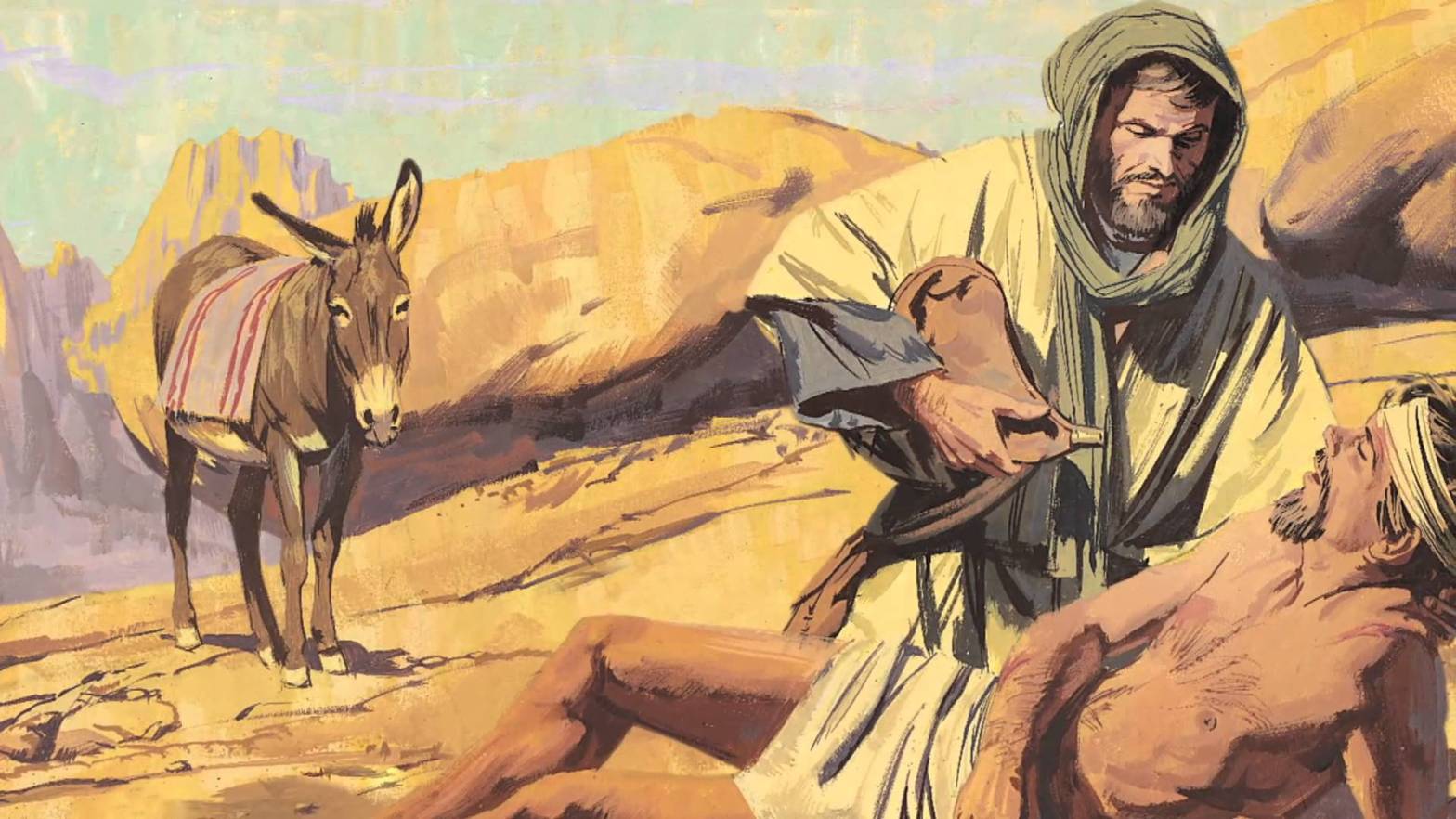
A Jewish man was traveling from Jerusalem down to Jericho, and he was attacked by bandits. They stripped him of his clothes, beat him up, and left him half dead beside the road. By chance a priest came along. But when he saw the man lying there, he crossed to the other side of the road and passed him by.
The man is half-dead, which, if you remember your Princess Bride, is close to “mostly dead.” And according to Jewish law, the priest would be unclean if he came into contact with a dead body, which would keep him from doing priestly duties. So here is a Jew, a man just like the injured man, who refuses to help. For all the right reasons, the priest makes the wrong choice—and walks on by.
A temple assistant walked over and looked at him lying there, but he also passed by on the other side.
The next person to pass by also shares the man’s faith. He actually works in the temple—perhaps he’s on the host team, or helps park the camels, or gets the coffee ready. If he is really great, he works over with the kids. He, too, is Jewish and he does one thing better than the priest: he actually walks over and looks at the half-dead man. But once he gets a good look he remembers that “half dead is mostly dead,” so he walks to the other side of the road, going out of his way to avoid him.
Imagine the crowd listening—imagine the expert in Jewish law. Jesus is telling a story about a Jewish man who was left helpless and dying by his fellow Jews—which is completely the opposite of everything they have been taught about loving your neighbor. If you are supposed to help anyone, it’s the people who are like you. Jewish people are supposed to help other Jewish people. Those were the rules. They were probably thinking: “If the people who look and think and act like me aren’t my neighbor, then who is? Where’s he going with this?”
The next words of the story show exactly where Jesus was going with this:
Then a despised Samaritan came along.
Samaritans were despised by Jewish people. Way back, long ago, they had been part of the same family line—they, too were descendants of Jacob. But because of intermarriage and conquest, the people of Samaria became “half-Jews.” So, for hundreds of years, the Jews had come to view the Samaritans as subpar, almost animals. They referred to the Samaritans as a “herd,” not as a nation or people. An old Jewish saying even said “a piece of bread given by a Samaritan is more unclean than swine’s flesh.”
Naturally, all of this led the Samaritans to hate the Jews, too. They so frequently attacked Jews travelling to Jerusalem that the Jews would go out of their way to avoid the entire region. Samaritans would even serve under the Romans because it gave them a chance to legally harass the Jews. Here we have two people, living in the same country, who could not have been further apart. They were divided—like our world today—by race, religion, and politics. And they did not see any reason to change that.
Going over to him, the Samaritan soothed his wounds with olive oil and wine and bandaged them. Then he put the man on his own donkey and took him to an inn, where he took care of him. The next day he handed the innkeeper two silver coins, telling him, ‘Take care of this man. If his bill runs higher than this, I’ll pay you the next time I’m here.’
The despised Samaritan is the one who stops. He not only looks at the man, he soothes his wounds. He does everything he can to stop the bleeding and heal the damage done. He makes his own journey more difficult by giving his ride up to the broken man. He takes him to the local motel and spends the night taking care of him. The next day, he hands the owner the value of two days’ wages to ensure his ongoing care—and promises to pay for whatever else the man might need.
Then Jesus just looks at his audience and asks, “Now which of these three would you say was a neighbor to the man who was attacked by bandits?”
Who showed mercy? Who showed compassion? Who crossed every conceivable line to stop and help? The teacher of the law can’t even bring himself to say the word “Samaritan.” He says, “The one who showed him mercy.”
Loving your neighbor as you love yourself sounds easy until we realize what Jesus is saying here. In a revolutionary little story that shakes up the notion of who our neighbor is, Jesus makes clear that our neighbor may not be the person who thinks and looks and acts like us. According to Jesus, our neighbor is just the opposite, and is someone you may not expect. You may not share the same skin color. You may not share the same religious beliefs. You may disagree politically.
In this story, Jesus is challenging us. He’s saying if we want to truly inherit eternal life—if we want to truly live the life He has called us to and created us for, we have to see everybody, even the people with whom we disagree and have nothing in common, differently.
Because when we come into the kingdom of God, these boundaries are set aside. What divides us is removed. He’s telling us we need to get close, get personal, give up our own comfort, and care about the people who are “not like us,” or not on “our” side. We don’t get to say that there is anyone who is “not like us.” There isn’t a “side.”
The world is built on boundaries and divisions. The kingdom of God is built on loving your neighbor as yourself. The world will tell us that the way to solve the problem is to vote for Hilary or Donald. To support this particular cause or stand for this one thing.
It’s been telling us that forever. It doesn’t seem to be working.
What will work, what will make the difference is when we—the people who love Jesus, who call him Lord—start living as if we are one. One church. One body. One family.
This story reminds me so wonderfully about why I love working with kids. Because kids aren’t naturally “for” or “against” anything. Except things like vegetables. That’s the hotbed topic on the playground—“What’s your stand on Brussels sprouts?” Kids will play and interact and love each other regardless of their differences. If a kid is hurt or crying, they don’t wait to find out the societal issues that might have caused it—they don’t ask who’s to blame, whose childhood caused the problem or what color skin the other kid has: they go get a bandaid. They see what’s wrong and they do everything they can to make it right.
At the beginning of the passage, a man asks, “Who is my neighbor?” You’ll notice Jesus doesn’t answer it. He leaves that to us, his audience. He simply tells the story and asks another question:
“Which of these would you say was a neighbor?”
How do you answer this question? Because if you answer it the way the man in the story did, your response isn’t optional.
The last thing Jesus says in the story is “Now go and do the same.”
That’s not “if you feel like it” or “if they don’t irritate you.” That’s a command, and our Savior is telling us to do it. To go, and do the same. To go into the world and be the Samaritan. To see beyond where we disagree, to see past what may divide us. Let us be a good neighbor to the world. To see our neighbors as Jesus sees them, because that’s what the kingdom of God is built on!
The world is broken. Jesus fixes it. Our job is to share Him with the world. We don’t need to chant a slogan or share a post on Facebook, we don’t need to stand up and sing “Ebony and Ivory.”
We need to LIVE this out. To truly love our neighbor as we love ourselves. Because when we do, the world will stop seeing us—and they will see only Him: our wonderful, amazing Savior—in whom there is no division, no sides, no “us” or “them.” Just Jesus. Or, as Paul said it,
“For you are all one in Christ Jesus.”
You Don’t Have to Build a Rollercoaster
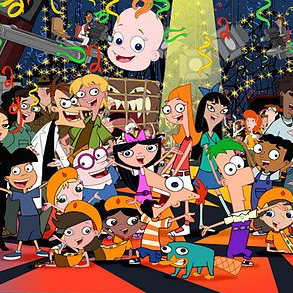
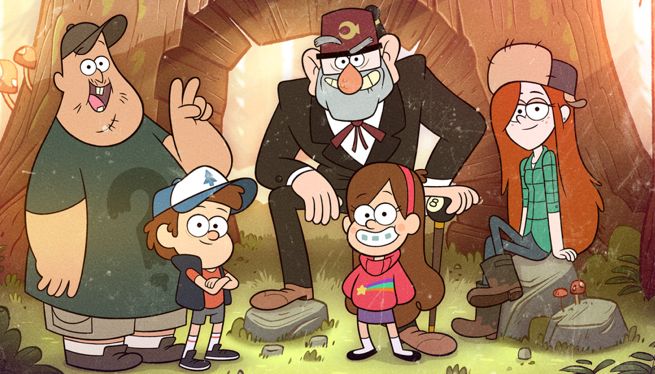
My favorite Disney cartoons of the past few years have been the ones about close family relationships. The “What are we going to do today?” question of Phineas & Ferb wouldn’t have been nearly as memorable without the genuine affection their sister Candace and their parents had for the inventive kids. Gravity Falls‘ weird and wonderful adventures would have been nothing without the incredible familial bond between Dipper, Mabel, and their Grunkle Stan. (I love this show so much, I even have an entire Vacation Bible Camp themed around it.)
Of the two, Phineas & Ferb speaks more dearly to my heart. For 104 days of summer vacation, Phineas and his less talkative brother Ferb would ask a question (“What are we going to do today?”) and then set out to answer it in the most engaging, life-changing way possible. Across its many seasons, the brothers and their friends engaged in incredible adventures each day of their summer break, making the most of every opportunity.
This isn’t a Disney idea. This is a God idea. The apostle Paul writes in Ephesians 5:16 that we needs to “Make the most of every opportunity” because we live in evil days. He writes frequently about running the race set before us, going after the prize, and not wasting the moments we are given. God did not create us to rest or wait or just be lazy. Like Phineas, He looks at you and asks, “So, what are you going to do today?” And by today, He means, your life: what are you going to do with it?

Phineas and Ferb built a rollercoaster. They flew to space, formed a band, bounced around the world, and frequently asked “Hey, where’s Perry?” And every time they were asked, “Aren’t you a little young to be….?” they answered, “Yes. Yes, we are.” But that doesn’t stop them. Like Paul says to Timothy: “Don’t be looked down upon because you are young! Be an example for the believers…” (1 Timothy 4:12)
The brothers set an example for all of us to be all that God created us to be. Don’t waste a moment. Don’t rest on your laurels. Don’t get comfortable. Just because what you did yesterday was great doesn’t mean you can’t do something even better tomorrow. Every bit of time given to you is the same bit of time given to Walt Disney, Albert Einstein, Sister Theresa, Marie Curie, Abraham Lincoln, Benjamin Franklin, JK Rowling–you get the idea.
Phineas and Ferb reminds us of this in several musical moments throughout the show. My favorites come from two different songs. The first is “Summer Belongs to You,” where the brothers manage to get their sister and friends around the world in one incredible day. Singing a song to sum it up, Candace sings these words:
Don’t waste a minute sitting on that chair
The world is calling you, just get out there
You can see forever so your dreams are all in view
Summer belongs to you!
Wise words from a cartoon sister. What are you waiting for? You don’t have to be an adult to make a difference. Start today. Ask yourself, “What am I going to do today?”
Still need motivation? In the episode, Rollercoaster: The Musical, the entire cast sings a song that sums up my entire motivation, and my hope for every child I’ve ever had the privilege of leading. The song harks back to a favorite film of my college years, Dead Poets Society. The song is called “Carpe Diem,” which is Latin for “Seize the Day.” Give it a listen.
So, if I have anything left to say to kids after talking with them 3 times a weekend for 8 years, it’s this: go be all that God created you to be. You are not defined my your age, by your family, your size, or anything else. God created you for something amazing. You can trust Him no matter what, and He gave you everything you need.
You don’t need to be a children’s pastor. You don’t need to build a roller coaster.
Every day’s a brand new day, so carpe diem.
Disney’s “Zootopia” is a Powerful Fable About What it Means to Be Human

The first thing you need to know about Disney’s Zootopia: it’s funny. It’s also clever, very witty, beautifully animated, and has a lot to say about life. In short, it’s more than just a cute idea–it’s a crime film, a comedy, and ultimately, a surprisingly deep study of what it means to be, well, human.
“In Zootopia, anyone can be anything.” This is the city’s motto, and it’s also the personal mantra that guides Judy Hopps (a winning vocal performance by Ginnifer Goodwin), a rabbit who longs to be more than a carrot farmer. Determined to be the world’s first bunny cop, she works hard to graduate head of her class at the academy and is recognized by Zootopia’s mayor with a plum assignment right in the heart of the city.

But once she gets there, she realizes anyone can’t be anything. Bunnies aren’t cops. They are meter maids. The real police work is for tougher animals: water buffalos, bears, elephants, rhinos. And more than that, lemmings still follow the herd, weasels are still shifty, and foxes are–well, sly.
The question Judy faces, along with sly co-hero Nick Wilde (fantastically voiced by Jason Bateman and animated by Bobby Huth), is can they be anything? Are they more than just the sum of their DNA? Are foxes always going to be sly? Are bunnies supposed to be just cute?
The film’s plot revolves around a Chinatown-like conspiracy where the predators of Zootopia (there are only mammals here, so no reptiles or birds) are suddenly turning wild. In the world of Zootopia, this is a thing of the distant past. The idea of a predator being feral, wild, and predatory is something relegated to stories told by children in school pageants. (A very funny school pageant, which is how the film brilliantly sets up the “big idea” of the movie.)

Forced to partner with Nick to prove herself, Judy sets out to solve the case. The story really takes off there, with a very even hand between satire and seriousness. It’s at once hilarious and heartwarming, and full of visual brilliance. Each district of Zootopia is brought beautifully to life, and it’s fun seeing how the filmmakers adapt human conveniences to their animal heroes. The scene with the sloths at the DMV is justifiably funny (it’s even better than it is in the trailers), the interactions with Chief Bogo are very good (Idris Elba is perfectly cast). The extended homage to the Godfather films gets a little long, although there is something funny about the words “skunk butt rug” that even the most highbrow viewer can appreciate.

However, Zootopia is more than just a “cute animal movie.” From the outset, it becomes clear that there is a bigger message involved, one that is a bit deeper than one might expect from an animated film. However, as C.S. Lewis once said, “Sometimes children’s stories say best what needs to be said,” and that is true for the story and message of Zootopia. It becomes clear very early that filmmakers Byron Howard and Rich Moore are going for a deeper story than Disney’s last animals-in-clothing film (Robin Hood).
It’s a parable of co-existence and tolerance that even the youngest kids in the audience will understand. (At one point Judy reminds someone that only bunnies are allowed to call each other “cute.” Make of that what you will.) It really begins to hit home after a big break in the case. After priding herself on working closely with Nick (who reveals a truly traumatic moment from his childhood) and helping him see that he can be more than just a sly fox, more than just a predator, Judy gets a chance to speak to the press.

In a scene that is uncomfortably accurate during our current political climate, Judy herself pushes the idea that perhaps the predators are only ever going to be that, causing widespread panic and prejudice, fanned by a press that wants to acerbate the situation with buzzwords and rhetoric. It’s an “us vs. them” mentality that is present at every political rally, and something that causes the fantasy world of Zootopia to hit pretty darn close to home.
Prejudice is apolitical. One party or movement doesn’t have the corner on it. Whether you are liberal or conservative, black or white, religious or not, you have some sort of prejudice in you. And this is the achievement of Disney’s latest animated film: it gets everyone to ask some really big questions about our prejudices and misconceptions. It’s a timely message, deftly presented with humor and grace.
Are we more than the product of our DNA? Can we see our neighbors and the people in our towns as something more? This is the big question that Judy and Nick must wrestle with, that the citizens of Zootopia must face. It’s also the big question Zootopia forces us to ask ourselves.

Too Much of a Good Thing

As a parent, I frequently think about what my kids pay attention to.
I can tell when they begin to spend too much time thinking about things that distract them from what’s important. When they think too much about a video game, I limit their game time. When they get obsessive over an artist or song, I limit how often they get to listen to it. Television, food, candy, sugar, social media–you get the picture.
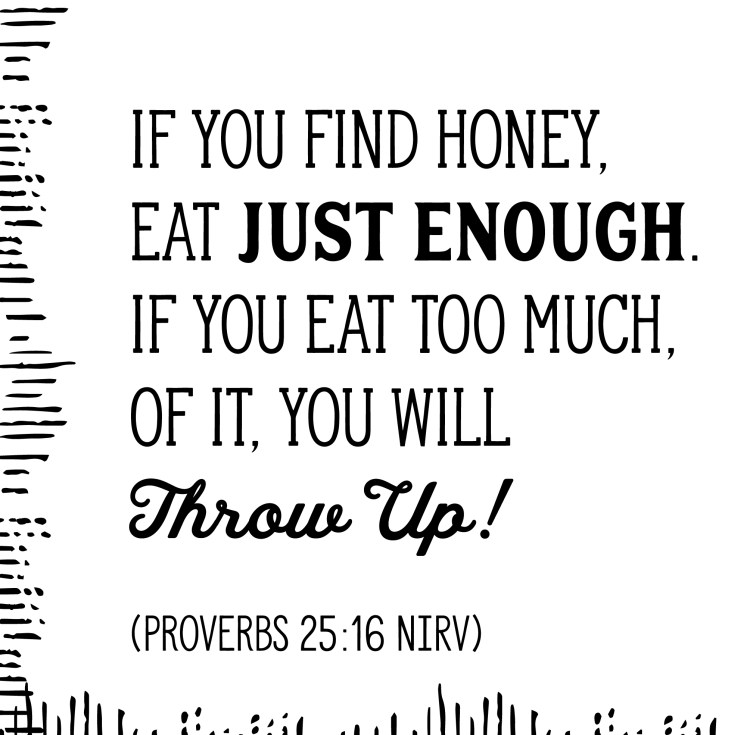
This is a biblical idea. Solomon wrote in Proverbs: “If you find honey, eat just enough. If you eat too much of it, you will throw up.” Short, sweet, and vivid. You can have too much of a good thing.
Whether it’s honey or the video game Fortnite or the music of Taylor Swift or Instagram or their latest bingewatch on Netflix–none of those things by themselves are bad. But too much of those things? Not good for them.
It’s easy to see this as a parent. We are quick to see what our kids need to stop doing, because we how it affects them. Their schoolwork suffers, their relationships with others go south, they sleep poorly–you get the idea.
It’s harder for us as adults to catch this for ourselves.
Football.
Exercise.
Television.
Career.
Vacation.
Social Media.
Money.
Politics.
All of these things are fine, in themselves. Rooting for a team is great. Being healthy is awesome. Enjoying a good show is relaxing. Having a job is always a plus. Getting away from it all is good. A few minutes with an app is a fun way to kill time. Money sure helps take care of the bills. And we kind of need to make sure our country has leaders.
But too much of any of these things will make you sick. And I don’t just mean feeling sick when your favorite team doesn’t do well. Anything–anything–that you get too much of will hurt you. Each of these things can consume you, become all you think about–and that’s the deepest trouble: they will distract you from what really matters.
Time with the kids.
Talking with your spouse.
Growing in your faith.
Deepening friendships.
Trusting in and relying on God.
You can have too much of a good thing. Solomon learned this the hard way. Once he filled his life with wealth, women, success, power, he lost his way. He stopped focusing on the one who gave him all of that, and his kingdom fell apart. He didn’t listen to his own warning.
I’d never want that for my kids. But God also doesn’t want that for me–or you. He’s not out to dispense heavenly Pepto-Bismol so we can feel better about ourselves after overindulging. He’d rather we make the wise choice to begin with.
So, before you lecture your kids on how much Xbox they play, or that singer they’re obsessing over, take a second to think about the “honey” in your own life. What’s distracting you from what really matters? It might be time to admit that you have too much of a good thing.
And stop before you throw up. Because that’s just gross.
 Duane S. Montague